

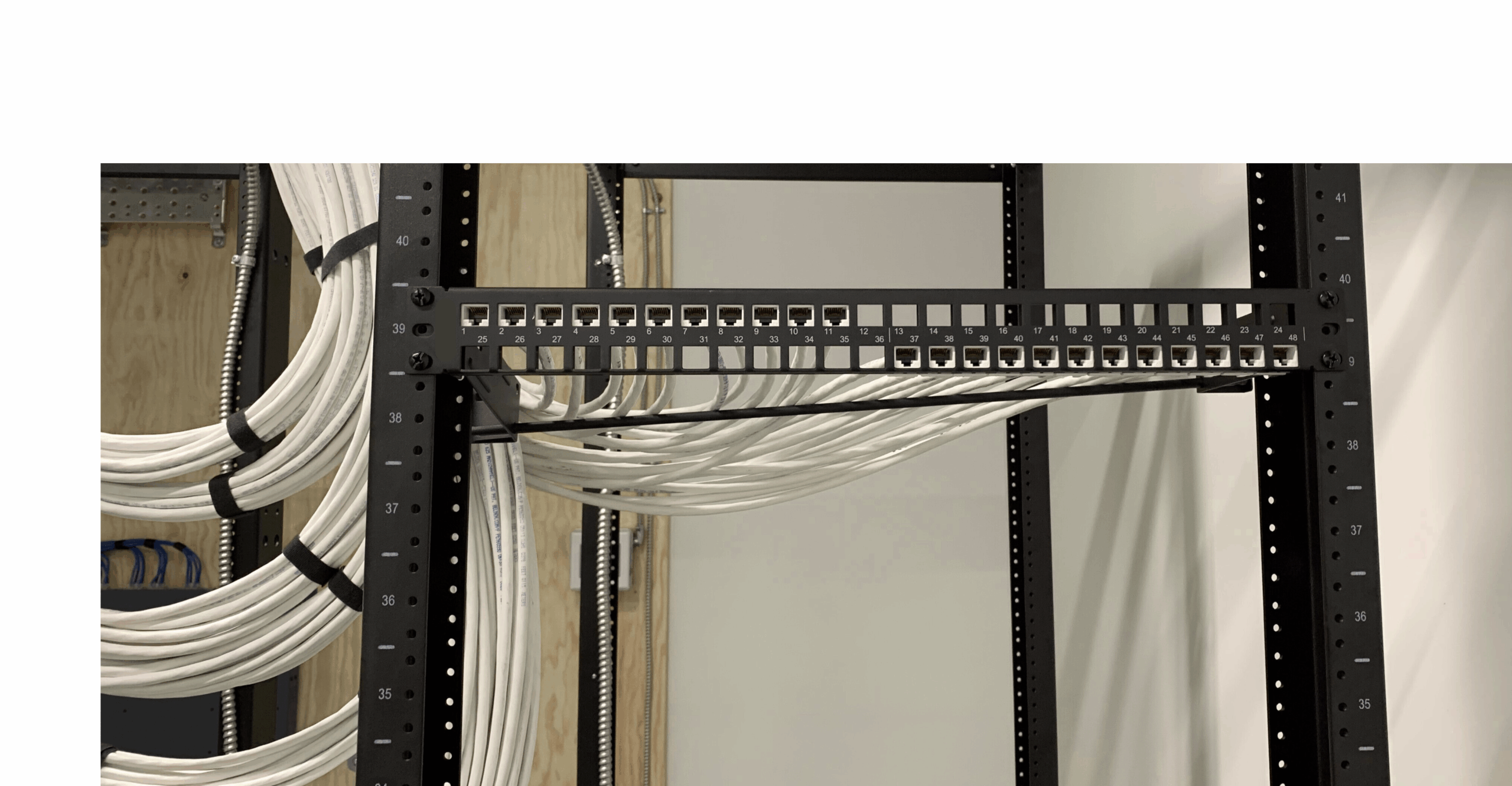
In 2026, structured cabling planning is being influenced by three forces: more bandwidth, higher power needs to peripheral network devices, and higher expectations for documentation and consistency for multi-site deployments. Here are the key trends to monitor for Canadian businesses, whether you are upgrading an office, expanding a warehouse, or standardising connectivity across multiple locations.
1) Fibre moves closer to the endpoint (not just the backbone)
Fibre cabling continues to show up earlier in the design conversation because it supports higher throughput, reduces risk of re-cabling during future upgrades, and fits well with modern network architectures that want more bandwidth headroom. For many Canadian projects, the practical question is no longer “fibre or copper,” but “where does fibre make sense now to avoid ripping things out later.”
2) AI and data centre investment is a demand signal for higher-performance infrastructure
Canada is actively positioning for more domestic compute capacity and data centre growth. Even if your cabling project is not a data centre, these developments influence real-world expectations around throughput, density, lead times, and the need for disciplined physical-layer design.
3) Wi-Fi 7 is now “real,” and wired uplinks must keep pace
Wi-Fi 7 is no longer a future spec. Certification began in 2024, and the underlying IEEE standard was finalised in 2025. That matters for structured cabling because higher-performing wireless typically means denser access point layouts and more pressure on cabling, switching, and PoE budgets.
4) PoE++ planning becomes standard for modern builds and retrofits
More endpoints draw power over Ethernet, and PoE++ (IEEE 802.3bt) supports higher-power delivery using four pairs. In 2026, a lot of “structured cabling scope” discussions will start to sound like electrical planning: power classes, heat considerations in bundles, switch capacity, and where higher-category cable reduces risk.
5) Smart building and physical security deployments keep adding endpoints
More sensors, cameras, access control, and operational technology endpoints increase cabling density and raise the stakes for clean pathways, labelling, and documentation. The more endpoints you add, the more expensive it becomes when “as-builts” are incomplete or the cabling plant is hard to manage.
6) Multi-site governance gets more formal (and buyers expect it)
Across Canada, public-sector standards and large enterprise practices reinforce a clear direction: consistent labelling, consistent testing, consistent close-out documentation. If you manage multiple offices, warehouses, or branches, the “governance” layer becomes a deciding factor because it reduces downtime and speeds up troubleshooting.
7) Cybersecurity expectations increasingly touch the physical layer
Canadian cybersecurity policy is moving toward stronger requirements around risk management, including supply chain and third-party considerations for critical systems. For many organizations, that shows up as more scrutiny around network room access, documentation integrity, and change control. Structured cabling is not “cybersecurity,” but it supports secure operations when it is documented, controlled, and auditable.
CORE is here to help you navigate through the changing landscape of structured cabling and wireless issues in Canada. Request a Free Quote to discuss a 2026-ready cabling plan for your office, warehouse, or multi-site rollout.
Sources:
Alberta.ca: https://www.alberta.ca/artificial-intelligence-data-centres-strategy
The Official Microsoft Blog: https://blogs.microsoft.com/on-the-issues/2025/12/09/microsoft-deepens-its-commitment-to-canada-with-landmark-19b-ai-investment/
ISED Canada: https://ised-isde.canada.ca/site/ised/en/canadian-sovereign-ai-compute-strategy
Parliament of Canada: https://www.parl.ca/legisinfo/en/bill/44-1/c-26
Ministère de la Justice: https://www.justice.gc.ca/eng/csj-sjc/pl/charter-charte/c26_1.html
Cisco Meraki Documentation: https://documentation.meraki.com/Wireless/Design_and_Configure/Architecture_and_Best_Practices/Wi-Fi_7_%28802.11be%29_Technical_Guide
Ethernet Alliance: https://ethernetalliance.org/wp-content/uploads/2018/04/WP_EA_Overview8023bt_FINAL.pdf
Ontario: https://www.ontario.ca/page/go-its-580tes-cabling-and-wiring-voice-and-data
